
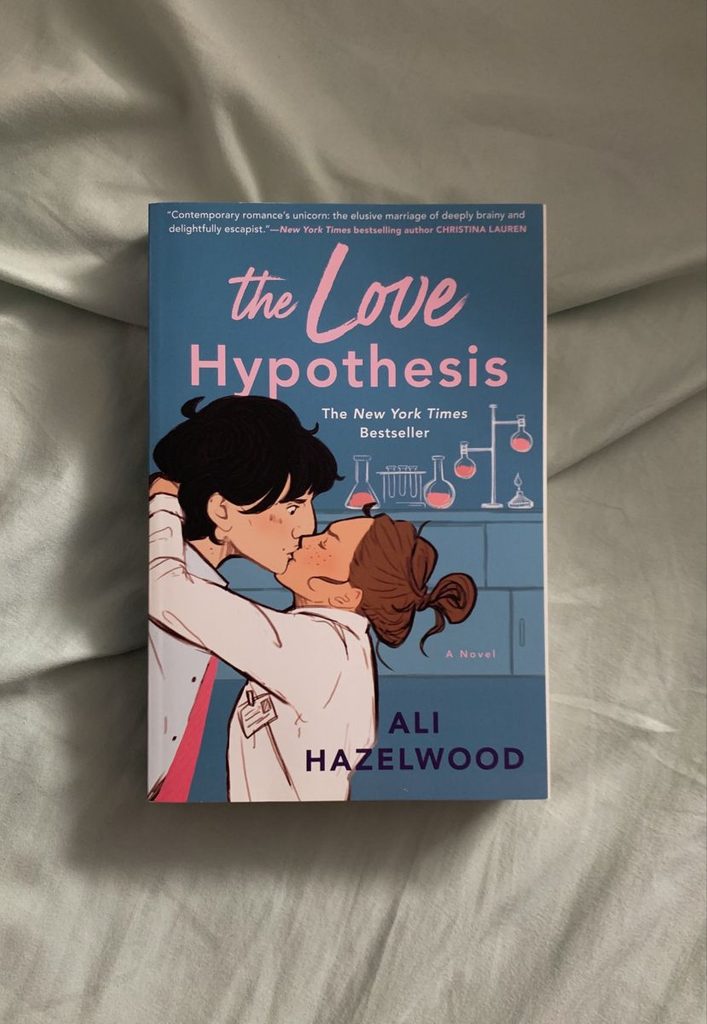
The Love Hypothesis” is one of my favorite rom-com books, so I finally watched the Prime Video movie with my boyfriend — and as far as book-to-movie adaptations go this year, this might be one of the best ones. But as someone who loved the book first, here’s my full Love Hypothesis movie vs book breakdown — 5 things I missed from the page. Spoiler warning ahead for both the book and the movie.
Quick List: Book vs. Movie Changes in The Love Hypothesis
1. Holden, My Dear, Where Were You?
In the book, I really loved Holden as Adam’s childhood best friend — the one who quietly supported the whole fake-dating scheme and gave Adam’s cold, stiff character some warmth by contrast. He’s not just comic relief either; he’s the person who nudges Adam toward being honest with himself about Olive, long before Adam’s ready to admit it out loud.
I would have loved to see him make it into the movie, but on the other hand, that might have been one character and subplot too many for a 112-minute runtime to carry well — this is exactly the kind of trade-off that comes up over and over in a Love Hypothesis movie vs book comparison. Adaptations always have to cut something, and losing Holden means losing a specific kind of warmth in Adam’s world — the proof that underneath the grumpy-professor exterior, he’s capable of real, easy friendship. The movie never quite finds a replacement for that.
2. The Ending of the Fake Relationship
In the book, Olive is the one who cuts off the fake relationship with Adam, once he’s about to interview for a position closer to Tom in Boston. Holden tells Olive that the only reason Adam even considered the opportunity was that she was going to be in Boston the next year too. It’s a quiet, devastating piece of information delivered by someone else, and it’s what pushes Olive to make the call herself — she’d rather walk away than watch him give something up for her without saying so.
In the movie, it plays out almost in reverse. Adam pulls away from Olive in the exact moment she needs him most — right after Tom sexually harasses her. She goes to confront him over how things have played out with his research funding, and he brushes it off, framing it as though he no longer needs her involved now that his funding has come through.
Tom has also gotten to Adam separately, convincing him that he needs a focused researcher next year, not someone distracted by a boyfriend she left behind in California. So Adam lets Olive go, believing — wrongly — that it’s the right thing to do for her career.
I understand why the movie made this change; it gives Adam an active, visible mistake to redeem himself from later, which works better dramatically on screen. But it does shift the emotional center of the breakup from Olive’s decision to Adam’s misjudgment, which is a fairly big swing for the story’s tone.
3. The Tom Benton Confrontation
One of the biggest swings in any Love Hypothesis movie vs book breakdown is how this scene plays out. In the book, Olive accidentally records Tom’s behavior toward her, and later confronts him in a restaurant in front of his Harvard colleagues. Tom tries to stop her from exposing him, but she plays the recording anyway — and Adam physically goes after him on the spot. It’s messy, satisfying, and very public in exactly the way Tom deserves.
In the movie, this scene is redistributed differently. Malcolm isn’t there for Olive this time; instead, she goes straight to Anh, who immediately senses something is wrong. Anh is the one who later tells Adam what Tom did, and Adam storms off mid-lecture to confront him — a much more public, but less physical, showdown than the book’s restaurant scene. It trades the raw fight of the book’s version for something a little more controlled, which fits the movie’s overall instinct.
4. Adam Knew Olive Before
This one’s a smaller change on paper for a Love Hypothesis movie vs book comparison, but it matters a lot for how the romance lands. In the book, this detail doesn’t come out until near the end: Adam remembered Olive from the very first time they met, in that bathroom encounter over her expired contact lenses — and he’d been thinking about her ever since. Finding this out late, after everything else that’s happened between them, hits differently; it creates a whole new dynamic to his behavior throughout the book.
In the movie, Adam tells Olive this himself, in a much cozier, quieter conversation while they’re walking home together — moving what was a late reveal in the book into an earlier, more intimate moment on screen. It’s sweeter in the moment, but it does trade away some of the slow-burn mystery the book builds around Adam’s motivations.
5. Whose Story It Is
The book leans heavily on Holden and Malcolm to carry information and emotional weight around Adam and Olive. With Holden gone from the movie entirely, a lot of that responsibility shifts onto Anh instead, who ends up with a much bigger role in the film’s back half than she has on the page.
It’s a smart compression for a two-hour runtime, even if it means losing some of the warmth the book has. The movie is, ultimately, a tighter two-hander focused on Olive and Adam, while the book gives its side characters more room to breathe. That’s really the heart of any Love Hypothesis movie vs book comparison — it’s not about which one is right, just which story each format is built to tell.
Honest Feelings as a Bookworm
As someone who was genuinely hooked on the book — my copy still has the well-loved, cracked-spine look of a book I picked up more than once — the movie made me feel the same way, which honestly surprised me a little. That said — and I think most readers already know this going in — the book is almost always going to be better than the movie. You simply can’t squeeze everything that a novel builds over 400 pages into a two-hour runtime, and something always has to give, whether that’s a character, a subplot, or a slower emotional build.
This is honestly the same lesson I keep relearning in every part of life, not just books — I wrote a whole post about it in things I wish I knew in my 20s: the “original” almost always beats the shortcut, whether that’s a novel over its adaptation or the long way over the easy one.
But even knowing that going in, this adaptation really did give me the vibe I wanted: the romance, the fake dating, the fun of watching two stubborn people fall for each other against their own better judgment. It’s not a perfect translation of the book, but it’s a genuinely enjoyable one on its own terms — which, for a BookTok favorite this beloved, is honestly a pretty high bar to clear.
None of these changes broke the story for me — if anything, doing this whole Love Hypothesis movie vs book exercise made me appreciate how differently the same fake-dating premise can land in two different formats. The movie trims the ensemble, tightens the timeline, and leans harder on Anh and Tom, while the book takes its time with a wider cast and a slower unraveling.
Different tools, same hypothesis: that these two were going to end up together no matter which version you’re watching.
BTW, my boyfriend approves as well. Hehe.
For the curious minds
FAQ: The Love Hypothesis Movie vs. Book
Is Holden in The Love Hypothesis movie?
No. Holden Rodrigues, Adam’s best friend in the book, was cut from the movie entirely, and his role in supporting Olive and Adam is redistributed mainly to Anh.
Who ends the fake relationship in The Love Hypothesis?
In the book, Olive ends the fake relationship. In the movie, it’s Adam who pulls away from Olive, believing he’s helping her focus on her career.
Does the confrontation with Tom happen the same way in the book and movie?
No. In the book, it happens in a restaurant and turns physical. In the movie, Adam confronts Tom during a lecture instead.
Is The Love Hypothesis movie faithful to the book?
n this Love Hypothesis movie vs book comparison, the film keeps the central fake-dating romance and most of the moments readers loved, but it makes real structural changes — cutting Holden, expanding Anh’s role, and changing how the third-act conflict plays out.
Is the book or the movie better?
Most readers, myself included, will say the book is better simply because it has more room to develop the full cast and a slower emotional arc. But the movie stands well on its own as a fun, well-cast romance that captures the core chemistry readers fell for in the first place.
What’s the biggest difference in this Love Hypothesis movie vs book comparison?
The biggest shift is emotional rather than structural: the book centers Olive’s decision to end the fake relationship, while the movie centers Adam’s misjudgment — which changes who the audience is rooting to “fix” things by the end.
Still Team Book. Still fan of the movie.
– D